
Blog
What Is Epithalon (Epitalon)? AEDG, Telomerase Research and Evidence Limits

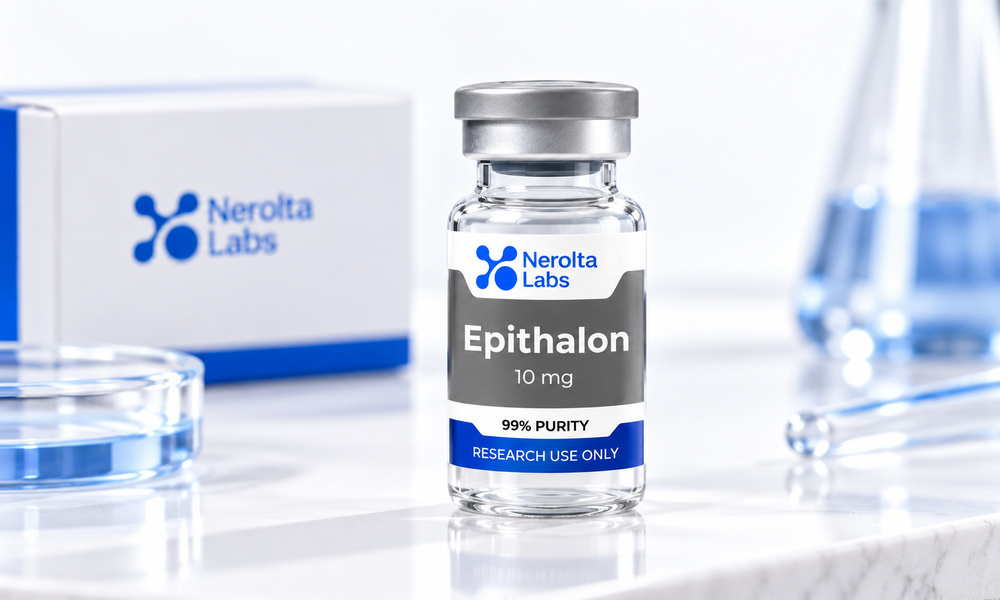
Updated October 2026 • 7 min read • Peptide-focused visuals aligned with Nerolta packaging
Epithalon (Epitalon) is commonly discussed as the AEDG tetrapeptide and should be distinguished from broader historical extracts.
Telomerase findings are model-dependent and do not establish a human longevity outcome.
Recent cell work adds evidence, but the overall literature still requires careful evidence-level labeling.
Epithalon is a small peptide with a very large reputation. It is also written as Epitalon or Epithalone and is often associated online with telomeres, telomerase, circadian biology and longevity. The most important first step is to separate the defined molecule from the broader claims surrounding it.
PubChem identifies Epitalon/Epithalon as the tetrapeptide Ala-Glu-Asp-Gly, abbreviated AEDG. Four amino acids make it structurally simple compared with many catalog peptides, but simple structure does not mean simple evidence.
What is Epithalon chemically?
Epithalon is a linear tetrapeptide with the amino-acid sequence alanine–glutamic acid–aspartic acid–glycine. PubChem lists the formula C14H22N4O9 and a molecular weight of approximately 390.35 g/mol for the reference molecule.
Those compact identity anchors are useful in procurement because they help distinguish the defined synthetic peptide from extracts, related short peptides and informal “longevity peptide” categories.

Why Epithalamin and Epithalon are easy to confuse
Much of the historical research tradition around Epithalon grew from work on pineal peptide preparations. Epithalamin was a mixture rather than one chemically defined four-residue peptide. Later research examined short synthetic sequences associated with that line of work.
This creates a recurring literature problem: a human observation made with a complex pineal preparation may be cited online as if the same result were established with synthetic AEDG. Researchers should trace the exact intervention described in each paper before transferring a claim.
What does the telomerase study actually show?
A frequently cited 2003 study reported that Epithalon induced telomerase activity and telomere elongation in a culture of telomerase-negative human fetal fibroblasts. That is scientifically interesting because telomerase controls a central component of telomere biology.
But a cell-culture result is not equivalent to demonstrating longer human lifespan, disease prevention or a validated clinical anti-aging effect. Cell type, concentration, experimental duration and assay conditions all matter. The correct statement is that telomerase-related activity has been reported in a particular experimental model.
Why “telomerase activation” is not automatically a benefit claim
Telomerase biology is context-dependent. Telomere maintenance is important in cellular replication, but telomerase is also active in many cancers. That does not mean Epithalon causes cancer, nor does it mean activating telomerase is inherently beneficial. It means the pathway is biologically complex and should not be reduced to “longer telomeres = longer life.”

How to read the Epithalon evidence base
- Cell studies: useful for mechanisms such as gene expression or telomerase-related observations.
- Animal studies: can explore organism-level endpoints but do not establish human efficacy.
- Human reports: must be checked carefully for whether the intervention was synthetic AEDG or a different pineal peptide preparation.
- Independent replication: matters because a concentrated research tradition can amplify one group’s findings across many citations.
What a laboratory buyer should verify
Because Epithalon is a small defined peptide, the quality questions are straightforward but still essential: correct sequence identity, molecular-mass support, chromatographic purity, lot-specific documentation and the physical form supplied. A generic “Epithalon” label is not the same thing as a verified lot.
Use Peptide Purity vs Peptide Content to understand why a high chromatographic percentage does not answer every composition question, and Batch Traceability to connect the vial to its COA.
Names matter: Epithalon, Epitalon, AEDG and the batch you actually receive
Search results use several spellings and labels for this tetrapeptide, which can create avoidable ambiguity in procurement records. A clean laboratory entry should preserve the name on the supplier listing while also recording the AEDG sequence context, the exact product presentation and the lot identifier. That makes it easier to trace later results back to a defined material rather than to a broad longevity-related keyword.
The practical value of this article is precision. It gives a reader enough context to avoid treating every “Epithalon” claim as equivalent, then sends that reader to the current Nerolta listing where the actual research product can be evaluated. The product page is where current price and presentation belong; the article is where evidence limits and terminology belong.
- Record the spelling used by the supplier and the AEDG identity in the laboratory notes.
- Do not turn telomerase-related preclinical findings into a guaranteed outcome for a purchased vial.
- Match any available batch documentation to the exact product and lot before archiving it with the experiment.
Why this matters for a laboratory buyer: the research question and the procurement decision should connect cleanly. A product page should make it easy to verify identity, presentation, current price and available batch information without relying on exaggerated outcome claims.
Before you order: make the product page part of the research record
Open the exact Nerolta listing and compare the compound name, current presentation, supplied form, storage wording, price and any available batch documentation against your laboratory SOP before purchasing.
After purchase, archive the order confirmation, lot identifier and supporting documentation with the experiment record. That creates a cleaner chain from literature review to procurement and makes reorders, troubleshooting and cross-lot comparisons easier.
Review Nerolta’s current Epithalon research listing
Open the product page to verify the current presentation and price while keeping the evidence limits in this guide in view.
View Epithalon research compoundBrowse all research compoundsFrequently asked research questions
Are Epithalon and Epitalon the same peptide?
They are common spelling variants used for the AEDG tetrapeptide.
Is Epithalon the same as Epithalamin?
No. Epithalon is a defined four-amino-acid synthetic peptide. Epithalamin refers to a broader pineal-derived peptide preparation used in parts of the historical literature.
Does one fibroblast telomerase study prove human longevity?
No. It reports a cell-culture observation. Human longevity is a much broader biological and clinical claim requiring different evidence.
Why a four-amino-acid peptide still requires analytical verification
Because AEDG is small, it can look conceptually simple compared with longer research peptides. But a short sequence still requires correct synthesis, purification, identity confirmation and lot control. Closely related short peptides, counterions, residual solvents and water can all affect the material supplied. A four-residue name is therefore not a substitute for a lot-specific analytical record.
Mass spectrometry is particularly useful as an identity check because the theoretical molecular mass is well defined. HPLC can provide chromatographic purity information, but—as with longer peptides—a large main peak does not independently prove that the peak is AEDG.
Why concentration of the literature matters
A substantial portion of the Epithalon and Epithalamin literature is connected to a relatively narrow research tradition. That does not make the findings invalid, but it affects confidence. Independent replication across laboratories, methods and model systems is one of the ways science distinguishes a robust effect from a finding that depends heavily on one group’s experimental framework.
When evaluating a dramatic claim, researchers should ask who performed the study, whether the exact experiment has been independently replicated, whether the intervention was AEDG or a broader peptide extract, and whether the endpoint was molecular, cellular, animal or human.
Telomerase activity and telomere length are related but not identical endpoints
Telomerase is an enzyme complex involved in maintaining telomeric DNA. Telomere length is the structural endpoint that reflects a balance of shortening and maintenance over time. A study can measure enzyme activity, gene expression, telomere length or replicative capacity, and those readouts are not interchangeable. Good Epithalon content should state which endpoint a paper actually measured.
Red flags in commercial Epithalon content
- Human longevity claims supported only by cell-culture papers.
- Epithalamin studies presented as if the intervention were synthetic AEDG.
- “Telomerase activation” presented as universally beneficial with no biological context.
- No distinction between molecular identity and a vendor’s purity percentage.
- No lot-specific documentation while making strong research-grade claims.
Nerolta’s research library is designed to do the opposite: connect the compound name to the exact evidence type and then connect the vial to its analytical record.
Explore Epithalon for laboratory research
Review the Nerolta Labs Epithalon research listing and available product documentation before connecting literature claims to a specific lot.
References & further reading
- PubChem: Epitalon / Epithalon, CID 219042
- Epithalon peptide induces telomerase activity and telomere elongation in human somatic cells
- Overview of Epitalon — highly bioactive pineal tetrapeptide
