
Blog
How to Choose a Research Peptide Supplier in 2026: COAs, Testing and Red Flags

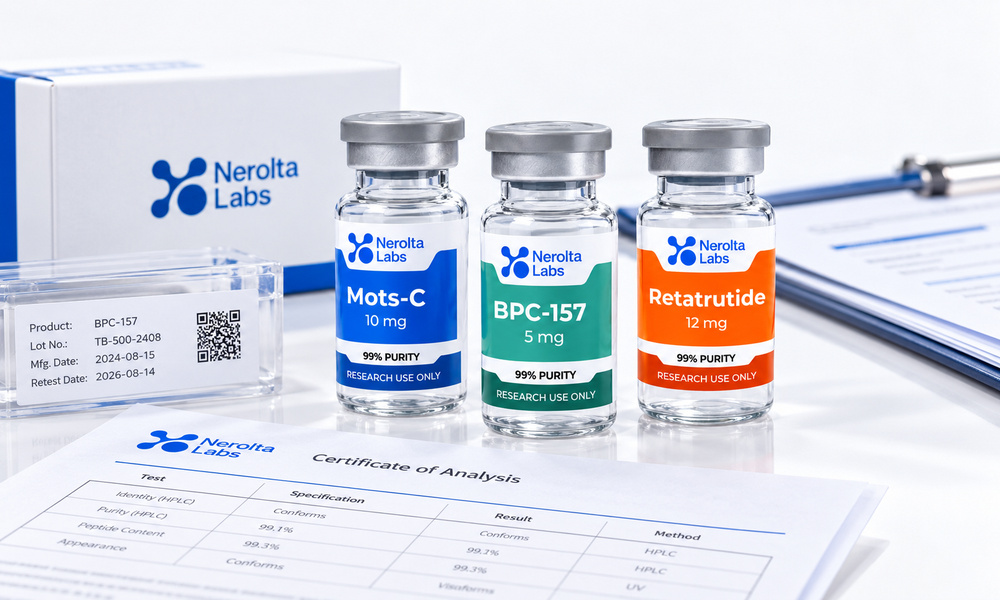
Updated October 2026 • 9 min read • Peptide-focused visuals aligned with Nerolta packaging
A credible supplier should connect each lot to specific analytical documentation rather than a generic quality badge.
HPLC purity and mass-based identity are different checks; neither should be presented as if it answers every quality question.
Transparent lot numbers, test dates, methods, fulfillment information and research-use positioning are practical buyer signals.
Choosing a research peptide supplier should be treated as a quality-control decision, not a branding decision. A polished storefront, a “99% purity” badge or a long catalog can tell you what a company wants to communicate. They do not, by themselves, establish what is in a particular vial or whether the analytical record shown online belongs to that lot.
For laboratory buyers in 2026, the useful question is more specific: can this supplier connect a defined research material to traceable, interpretable and lot-specific evidence? That question turns a vague supplier comparison into a repeatable procurement workflow.
A fast supplier scorecard
Before reading marketing copy, check whether the supplier makes the following information easy to find. No single row proves quality, but the pattern is informative.

1. Start with a lot-specific COA, not a quality badge
A certificate of analysis is most useful when it identifies the specific lot it describes. That sounds obvious, yet the peptide market contains certificates that function more like marketing graphics than batch records. A logo, a chromatogram screenshot and a large purity number can still be disconnected from the vial a researcher actually receives.
Look for a lot or batch identifier, sample or product name, test date, analytical method and result. Then compare the identifier with the physical label or product documentation. If the supplier cannot explain how the certificate maps to the material, the document has limited traceability value.
Nerolta’s guide to peptide lot numbers and batch traceability goes deeper into how that chain should work.
2. Verify identity and purity as separate questions
One of the easiest ways to overestimate a supplier’s testing is to treat every laboratory number as interchangeable. They are not.
HPLC separates components under defined chromatographic conditions and is commonly used to report relative peak-area purity. Mass spectrometry provides mass-to-charge information that can support molecular identity. A quantitative content assay addresses another question again: how much target material is present on a defined basis.
A supplier that presents “99% HPLC” as if it simultaneously proves sequence identity, vial quantity, sterility, endotoxin status and every other property is collapsing multiple measurements into one claim. For the analytical distinction, see HPLC vs LC-MS for research peptides and peptide purity vs peptide content.
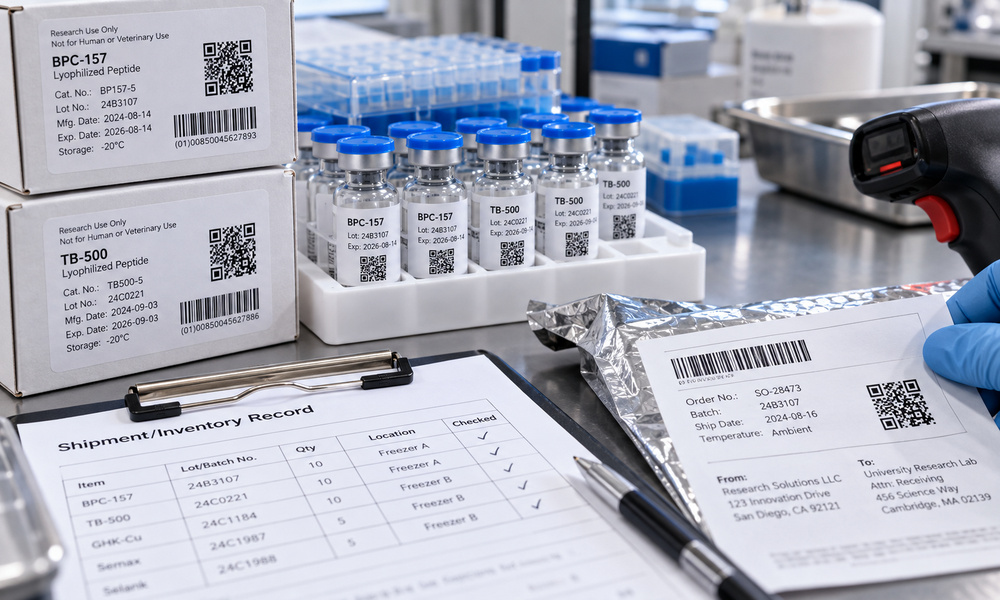
3. Match the vial, lot number, test date and certificate
Traceability becomes stronger when four pieces agree: the product identity, the lot printed on the vial, the lot shown on the analytical document and the date of testing. A researcher should be able to move from the physical sample to its record without guessing.
This also helps with reproducibility. If an experimental result changes months later, lot identity and handling history become part of the investigation. Without them, it is difficult to distinguish a biological change from a material or storage variable.
4. Ask what “third-party tested” actually means
“Third-party tested” is useful only when the third party and the test are meaningful. The phrase should prompt follow-up questions:
- Which laboratory performed the analysis?
- What method was used?
- Was the sample identified by lot?
- Is the result a raw analytical output, a summarized certificate, or both?
- Does the certificate identify when testing occurred?
Independent testing can reduce conflicts of interest, but an unnamed laboratory logo is not automatically stronger evidence than a transparent, interpretable analytical record.
5. Evaluate fulfillment and storage claims without assuming a universal rule
Peptides differ in sequence, formulation and physical form, so a universal storage slogan is not a substitute for material-specific documentation. What matters operationally is whether the supplier communicates how a product is packaged, how orders are fulfilled and what storage information accompanies the material.
For the receiving laboratory, the chain continues after delivery. Temperature history, moisture exposure, light, container closure and repeated handling can all matter depending on the product. The practical framework is covered in How to Store Research Peptides.
6. Read the marketing language as a quality signal too
A supplier can have attractive analytical documents and still undermine its credibility with unsupported human-use marketing. In the United States, regulators have repeatedly scrutinized sellers that label products “research use only” while surrounding them with dosing, injection, disease-treatment or body-composition claims.
For a laboratory buyer, the cleanest positioning is also the easiest to understand: defined research compounds, analytical documentation, handling information and clear limits on intended use. A supplier should not require the researcher to separate a laboratory product from pages of consumer-medical promises.
7. Compare price only after comparing what is documented
Price matters, but comparing vial prices before comparing specifications can create a false equivalence. Two listings with the same compound name may differ in stated amount, salt form, test coverage, batch documentation, packaging or fulfillment practices.
The more useful comparison is documented material for the research objective, not simply the lowest number beside a product name. This is especially important in a category where the word “premium” is easy to add and difficult to measure.
Research peptide supplier red flags
A five-minute due-diligence workflow
- Define the exact compound. Confirm sequence/name and relevant form rather than relying on a category nickname.
- Open the lot documentation. Find the lot identifier, date, method and reported result.
- Separate the measurements. Identify which result addresses chromatographic purity, molecular identity or quantitative content.
- Check traceability. Make sure the material you would receive can be linked back to that documentation.
- Review the research-use language. Avoid suppliers whose human-use marketing contradicts their stated product category.
- Confirm practical fulfillment details. Know where questions about shipping, damaged material or documentation will be handled.
Why supplier quality matters to reproducibility
Procurement is part of experimental design. If a material is poorly identified, inconsistently documented or impossible to trace, uncertainty enters the study before the first assay begins. Better supplier documentation does not guarantee a biological result—but it reduces avoidable uncertainty about the material being tested.
That is why Nerolta’s research library treats “research grade”, analytical methods and batch traceability as connected topics rather than separate badges.
Evaluate the material, not just the listing
Explore Nerolta’s research compounds and compare product identity, available documentation and research context before selecting material for a laboratory project.
Apply this scorecard to Nerolta too
A useful supplier guide should not ask readers to scrutinize competitors while giving the publisher a free pass. Apply the same questions to Nerolta: is the compound identity clear, is the price visible, can the buyer distinguish product presentation from scientific claims, can the relevant lot information be recorded, and is the research-use positioning explicit? If any detail needed for a laboratory purchase is unclear, the right next step is to resolve it before checkout.
That transparency also helps qualified researchers make more deliberate purchasing decisions. A researcher who understands the difference between identity, purity, content and traceability is more likely to use the catalog deliberately, compare the correct products and retain the documents that matter. The goal is not a louder claim of quality; it is a shorter path from a quality question to a checkable product detail.
- Use visible pricing and product identity to compare like with like rather than choosing from a headline claim alone.
- Match any available analytical document to the exact compound and lot before treating it as evidence for the material.
- Keep the research-only terms and intended use clear throughout the purchase decision.
- If the information needed for your laboratory record is missing or ambiguous, ask the supplier before ordering.
Why this matters for a laboratory buyer: the research question and the procurement decision should connect cleanly. A product page should make it easy to verify identity, presentation, current price and available batch information without relying on exaggerated outcome claims.
Before you order: make the product page part of the research record
Open the exact Nerolta listing and compare the compound name, current presentation, supplied form, storage wording, price and any available batch documentation against your laboratory SOP before purchasing.
After purchase, archive the order confirmation, lot identifier and supporting documentation with the experiment record. That creates a cleaner chain from literature review to procurement and makes reorders, troubleshooting and cross-lot comparisons easier.
Evaluate Nerolta with the same checklist
Open the Nerolta catalog and compare product identity, current price, presentation and available documentation using the criteria in this guide.
Explore Nerolta research compoundsReview HPLC vs LC-MSFrequently asked questions
What should I look for in a research peptide supplier?
Look for traceable lot documentation, named analytical methods, identity and purity evidence, clear research-use positioning, transparent fulfillment information and a way to resolve questions about a specific batch.
Is a 99% HPLC result enough to choose a supplier?
No. It can be useful chromatographic evidence, but it does not by itself answer molecular identity, quantitative peptide content, sterility, endotoxin status or lot traceability.
Should a COA match the lot on the vial?
Yes. Lot matching is one of the most practical ways to determine whether the analytical document actually describes the material being evaluated.
Does “third-party tested” automatically mean high quality?
No. The usefulness depends on who performed the test, which method was used, whether the sample is lot-specific and whether the results can be interpreted.
Sources and further reading
- U.S. FDA — Peptide Partners LLC warning letter (2026)
- U.S. FDA — Gram Peptides warning letter (2026)
- Nerolta Research Library — HPLC vs LC-MS for Research Peptides
- Nerolta Research Library — Peptide Lot Numbers and Batch Traceability

2 thoughts on “How to Choose a Research Peptide Supplier in 2026: COAs, Testing and Red Flags”
Comments are closed.