Blog
What Are Peptides? Definition, How They Work, Types and Research Uses


Updated October 2026 • 6 min read • Peptide-focused visuals aligned with Nerolta packaging
Peptides are amino-acid chains whose function depends on sequence, structure and research context.
General peptide education should be connected to identity, purity and supplier-evaluation concepts.
Broad peptide traffic becomes valuable when it routes readers into more specific procurement and research guides.
Peptides are short chains of amino acids linked by peptide bonds. That simple definition is useful, but it leaves out the reason peptides matter so much in research: once amino acids are connected in a defined sequence, the resulting chain can participate in signaling, binding, transport and many other biological processes. In other words, a peptide is not just a small piece of chemistry. It is often a highly specific biological message or tool.
Interest in peptides has accelerated because peptide-related compounds now sit at the intersection of metabolic research, longevity research, tissue-repair research and analytical biochemistry. As search interest grows, so does confusion. Many pages collapse very different things into the same label: natural peptides, synthetic research peptides, therapeutic peptide drugs and even larger proteins are often discussed as if they were interchangeable. They are not.
What a peptide is in simple terms
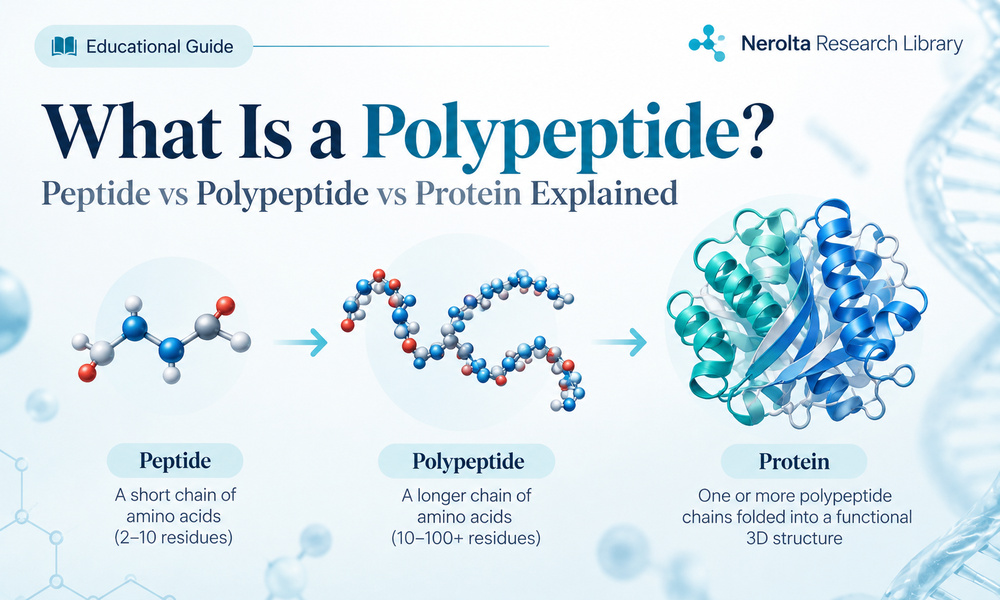
A peptide is a chain of amino acids. Amino acids are the building blocks used by living systems to construct many biologically active molecules. When a relatively short chain is formed, researchers usually call it a peptide. When chains become larger and fold into more complex structures, the discussion often moves into polypeptides and proteins. The exact boundary can vary by context, which is one reason people searching what is a peptide often get conflicting answers.
The most useful way to understand peptides is through function. Many peptides act as signaling molecules. Some bind to specific receptors, some influence enzyme activity, and some are studied because they help researchers model larger biological systems. From a laboratory perspective, peptides are valuable because sequence, purity, identity and format can all be defined and tracked.
How peptides work
The phrase what do peptides do is broad because peptides do not all do one thing. A peptide’s behavior depends on its amino-acid sequence, three-dimensional conformation and the environment in which it is studied. Some peptides interact with cell-surface receptors. Others act inside cells or serve as analytical targets. In receptor-focused research, even a small change in sequence can alter potency, selectivity or stability.
That is why serious peptide research depends on accurate identification and documentation. A page may describe a peptide’s proposed mechanism, but a laboratory still needs to confirm what material is actually in a vial. As we explain in our guides on peptide purity versus content and HPLC versus LC-MS, marketing language and analytical verification are not the same thing.
Types of peptides researchers commonly discuss
- Endogenous peptides: peptides produced naturally in biological systems.
- Synthetic research peptides: lab-made peptides used for controlled studies.
- Peptide blends or stacks: products combining more than one research peptide, which require even more careful documentation.
- Therapeutic peptide drugs: regulated medicinal products that should not be confused with research-use-only compounds.
This distinction matters commercially and scientifically. A searcher may look for general peptide information, but the intent often becomes procurement-related very quickly. That is why a strong educational page should answer the basic question while also showing how to evaluate product identity, supplier transparency and research-use positioning.

Peptides, polypeptides and proteins are related—but not identical
Peptides, polypeptides and proteins all involve amino-acid chains, but the scale and complexity change. A simple peptide may contain only a short chain and limited folding. A polypeptide is a longer amino-acid chain that may or may not fold into a functional final structure. A protein is generally a larger, structurally organized molecule whose function depends on that architecture. For a deeper breakdown, see our companion guide on peptide vs polypeptide vs protein.
What laboratory buyers should verify when evaluating research peptides
- Identity: the peptide name, sequence context and documentation should match.
- Lot traceability: the vial should connect to a specific batch or lot record.
- Analytical support: methods used to evaluate the material should be clear.
- Research-use framing: the supplier should communicate the research context responsibly.
- Storage and handling information: laboratory teams need practical documentation to preserve records and reproducibility.
These checkpoints help bridge education and purchasing. Someone searching what are peptides used for may start with a general information need, but a high-quality page should also guide them toward evidence-based procurement decisions. That is where a scientific content strategy becomes commercially useful.
Why this topic matters for SEO and for real buyers
The term peptides attracts broad curiosity traffic, but broad traffic only becomes valuable if the page also builds trust. A strong foundational article should rank for informational variants like what are peptides and what is a peptide, while channeling readers toward more specific guides such as how to choose a research peptide supplier and what research grade means.
From peptide basics to real sourcing decisions
Broad peptide education attracts attention, but laboratory teams eventually need something more practical: what material to compare, how to verify it and which documentation to keep with the experiment. That is where strong educational content becomes commercially useful.
After reviewing the category-level differences, the next step is to compare supplier transparency, batch documentation and product presentation across actual research compounds.
- Use educational pages as an entry point, then move into batch-specific evaluation before purchasing.
- Compare research-use framing and available analytical support, not just the compound name.
- Keep product and lot records tied to the experiment so later findings remain reproducible.
Why this matters for a laboratory buyer: the research question and the procurement decision should connect cleanly. A product page should make it easy to verify identity, presentation, current price and available batch information without relying on exaggerated outcome claims.
Before you order: make the product page part of the research record
Open the exact Nerolta listing and compare the compound name, current presentation, supplied form, storage wording, price and any available batch documentation against your laboratory SOP before purchasing.
After purchase, archive the order confirmation, lot identifier and supporting documentation with the experiment record. That creates a cleaner chain from literature review to procurement and makes reorders, troubleshooting and cross-lot comparisons easier.
Continue into the research compounds catalog
Open the catalog to review Nerolta’s current research compounds and compare them with the needs of your laboratory project.
Browse compoundsRead supplier guide
Frequently asked questions
Are peptides the same as proteins?
No. Peptides are generally shorter amino-acid chains, while proteins are usually larger and structurally more complex. They are related categories, but not identical terms.
What are peptides used for in research?
Researchers study peptides in receptor biology, metabolism, signaling, analytical chemistry and other specialized fields. The exact use depends on the peptide and the research model.
Why does supplier documentation matter?
Because the scientific literature describes molecules conceptually, while procurement requires evidence about the actual material being supplied. Documentation connects those two worlds.
Explore research peptides with stronger context
Once you understand the category, the next step is comparing actual research compounds, documentation and supplier transparency.