Blog
What Is GLOW Peptide? Blend Ingredients, Naming and Research


Updated October 2026 • 6 min read • Evidence-led scientific and laboratory visuals
GLOW is a commercial blend term, not a universally defined molecule.
GHK-Cu, BPC-157 and TB-500 each have distinct research contexts.
A combination’s quality and evidence cannot be inferred from its ingredients alone.
“GLOW peptide” is primarily a commercial nickname for certain multi-peptide blends. It is not a universally defined, standardized single peptide sequence. Many online descriptions associate the name with GHK-Cu, BPC-157 and TB-500, but sellers can use the term differently. A serious buyer should look first at the actual component list rather than the nickname.
The name travels well on social media because it suggests a visible outcome. That is precisely why research content must define it carefully. A name designed to be memorable is not a scientific endpoint, and it does not validate skin improvement, regeneration or other clinical claims.
Does GLOW describe one ingredient or a blend?
Unlike a specific molecule such as KPV, “GLOW” does not define a single amino-acid sequence. In typical market usage it refers to a combination concept. The composition may include copper peptide GHK-Cu plus two other peptides associated with injury-related research. A buyer should obtain the exact product name, component identity, ratio and analytical basis before treating two GLOW-labeled products as comparable.

Why GHK-Cu is often mentioned in GLOW searches
GHK-Cu is the copper complex of glycyl-L-histidyl-L-lysine. Laboratory research has explored its interactions with extracellular matrix and skin-related processes. Reviews describe promising mechanistic data while emphasizing limitations in the clinical evidence base. These observations concern particular preparations and study designs, not the effectiveness of every product containing GHK-Cu.
If the searcher wants copper-peptide biology rather than a blended-product description, our copper peptides guide and GHK-Cu research overview address that subject directly.
The other two names do not automatically add a new proven benefit
BPC-157 and TB-500 are often grouped with GHK-Cu because all three are discussed in the broader peptide-research market. But a blend containing three components does not become clinically validated simply because each has a distinct preclinical literature. Any proposed interaction would need a study of the combination itself.
Different experiments would also be required to distinguish the role of each component. Without controlled comparisons, a result from a mixed sample cannot be attributed cleanly to one ingredient. This is a particularly important consideration when a product is purchased for research reproducibility.
How to assess a blend from an analytical perspective
A single-component COA is not automatically a complete blend COA. Mixtures can present challenges for identity, quantitation and interpretation because the analytical method must distinguish multiple compounds. The supplier should explain what the reported results actually measure; a generic percentage without method details does not resolve whether individual components were verified.
This question connects directly to our research peptide blends guide and HPLC/LC-MS explainer.
A useful naming standard for the laboratory notebook
Rather than writing only “GLOW” in the experimental log, record the full listed composition, formulation and lot. If a supplier changes ratios or ingredients while retaining the same nickname, two experiments using the “same” label could actually involve different substances. Scientific traceability depends on the explicit recipe, not the marketing identity.
The same principle helps catalog SEO. The headline can acknowledge the term readers search, while the body anchors that term to actual component names, evidence boundaries and a truthful current product listing.
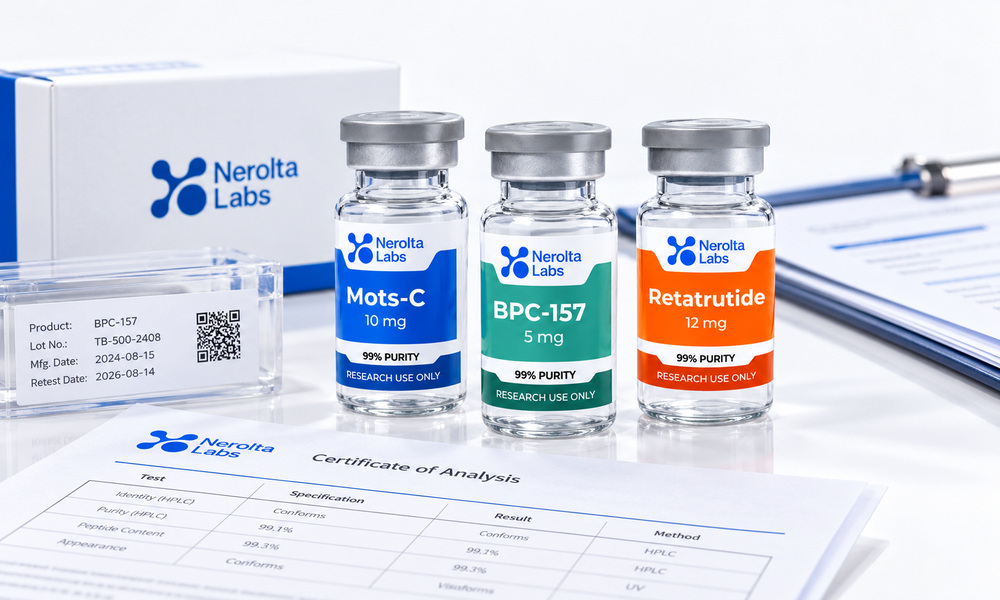
How Nerolta’s catalog relates to the GLOW search
Nerolta currently lists a product titled GHK-Cu | TB-500 | BPC-157. That is a logical research catalog destination for readers investigating this ingredient combination. However, the article should not assert that the supplier labels it “GLOW” unless the live product page actually does so. Clear navigation from a popular search term to a verified product description is more valuable than retrofitting the catalog with an unverified nickname.
Qualified laboratories should compare the current product presentation, its component list and documentation with the needs of their experimental plan. The page should not imply a skin, athletic or medical outcome for human use.
The questions a serious laboratory buyer should ask
- What are the exact three components, and are they present in this specific product?
- Which compound or fragment does “TB-500” refer to in this listing?
- How does the supplier distinguish each component analytically?
- Is the batch/lot information traceable to the delivered blended item?
- Are the experimental claims limited to what the literature actually studied?
Inspect the verified combination components
A relevant blended listing is the right bridge from GLOW searches, provided the article does not replace a real ingredient list with an assumed formula.
For a qualified laboratory, the next meaningful step is to verify the current product identity, packaging, lot-level information and available documentation against its own research requirements.
- Verify the exact compound or components and the intended in vitro/laboratory context.
- Request lot-matched analytical documentation where available; do not substitute a marketing purity badge.
- Retain the listing, batch record and order details for reproducibility and internal review.
Why this matters for a laboratory buyer: the research question and the procurement decision should connect cleanly. A product page should make it easy to verify identity, presentation, current price and available batch information without relying on exaggerated outcome claims.
Before you order: make the product page part of the research record
Open the exact Nerolta listing and compare the compound name, current presentation, supplied form, storage wording, price and any available batch documentation against your laboratory SOP before purchasing.
After purchase, archive the order confirmation, lot identifier and supporting documentation with the experiment record. That creates a cleaner chain from literature review to procurement and makes reorders, troubleshooting and cross-lot comparisons easier.
Inspect the verified combination components
Open the relevant Nerolta page to inspect current product details, or consult the research supplier guide before making an institutional purchasing decision.
Review GHK-Cu / TB-500 / BPC-157Read the supplier guide
Frequently asked questions
Is GLOW a single peptide?
Usually no. It is an informal name used for certain multi-peptide combinations.
Does every GLOW blend contain the same ingredients?
No standardized formulation should be assumed. Check each seller’s explicit ingredient list.
Is a GLOW blend proven to improve human skin or healing?
The combined product should not be described as clinically proven without direct, high-quality human evidence for that precise preparation.
Sources and further reading
The scientific and regulatory materials below provide context for the statements in this guide. Research findings are not instructions for human use.
- GHK topical research review
- BPC-157/TB-500 literature overview
- FDA safety considerations for selected peptides